A page is published only when its core facts can be traced, dated and checked again. Missing data remains visibly missing.
The minimum venue record
We require the official and display names, region, state, locality, street address, coordinates, phone, licence number and source, verification date, transport, parking, opening hours, responsible-gambling information, exclusive owner, intent and canonical URL.
Evidence hierarchy
Official regulator, government register or current operator source.
Directly verifiable venue information for operational details.
Independent geographic sources for locality and transport context.
Third-party directories only as discovery leads, never as sole proof for important facts.
Publication gates
A record is held if required fields are absent, ownership conflicts remain, the official status cannot be reconciled or a claim would rely on inference. The current venue set is held for these reasons. This is a feature of the method, not an error message to hide.
Dates and updates
Every material fact carries a source date and recheck date in the working ledger. We change a “checked” date only after a real review. Significant corrections are recorded in the update history.
Directions and “open now”
Directions require verified coordinates. “Open now” requires current structured hours and timezone-aware logic. Neither feature is activated merely because users expect it.
Island evidence brief · machine mechanics guide
Read the island record in three layers
Tasmania’s compact outline can make travel look simpler than it is. River crossings, mountain roads, ferry timing and the difference between Hobart and regional access all affect whether a venue detail is useful.
How we verify Tasmania venue information: the working question
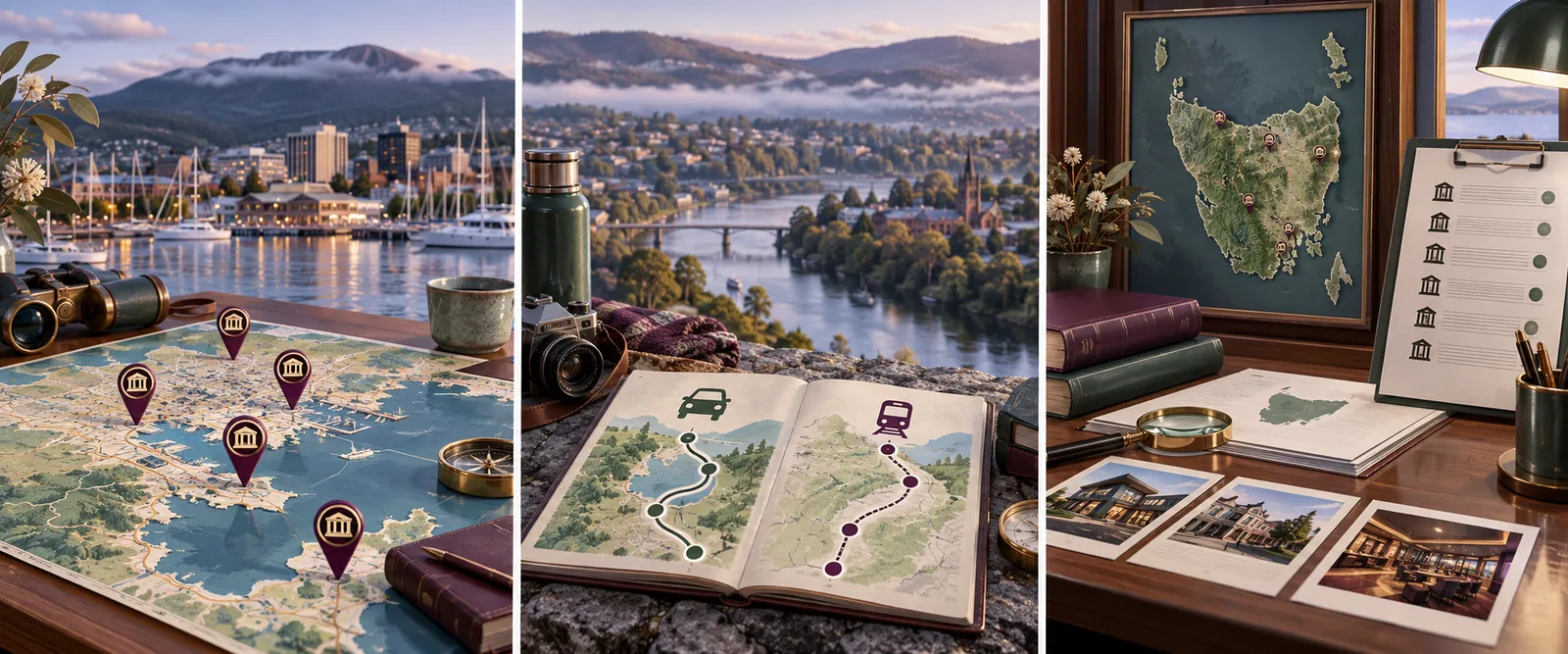
This page reads evidence in three layers: the location, the journey and the record behind the claim. None of the illustrations is presented as proof of a real venue or current service.
It can explain random outcomes, return measures, volatility and common interface terms. It cannot turn population-level information into a prediction for one session.
The route key for this page is how-we-verify. It identifies the editorial scope; it is not a claim that every named place has the same rules, facilities or operating conditions.
Locate the scopeThe first panel frames “How we verify Tasmania venue information” inside Tasmania; it is an editorial illustration, not a live venue map.
Test the journeyThe route panel prompts a same-day transport and access check for How we verify Tasmania venue information; it does not provide turn-by-turn navigation.
Audit the claimThe evidence panel shows the review process for How we verify Tasmania venue information.
01 / Identify
Define exactly what “How we verify Tasmania venue information” covers
Start with the page title, locality and jurisdiction rather than a broad keyword. Record whether the reader is trying to understand a rule, compare an area, inspect one venue record or plan a route. A precise question prevents unrelated facts from being combined into a confident but unusable answer.
02 / Verify
Prefer the source closest to the claim
Regulators and legislation support legal statements; an operator supports current hours and facilities; transport agencies support network information. Third-party directories can reveal a lead, but they do not settle a conflict. When sources disagree, show the uncertainty and the date instead of choosing the most convenient version.
03 / Recheck
Make the plan resilient to change
Choose the locality, compare realistic travel options, then return to the cited source before relying on hours, ownership or facilities. Recheck time-sensitive details shortly before departure and keep a practical alternative. This is especially important for holiday hours, regional services, construction, accessibility arrangements and any listing that depends on a single uncorroborated source.
Compact comparison
What belongs in the decision
Place
Exact locality, jurisdiction and geographic boundary.
Evidence
Primary source, independent cross-check and review date.
Access
Route, operating window, parking, transit and accessibility.
Limits
What is unknown, time-sensitive or outside this page’s scope.
Questions to answer before relying on this page
Is the information current enough for a visit?
Use the review date as a prompt, not a guarantee. Recheck dynamic details with the venue, regulator or transport operator that controls them.
Do the illustrations show real venues?
No. They are purpose-made editorial scenes used to explain location, route and verification. They do not depict a confirmed venue, available machine or guaranteed facility.
What should be reported as a correction?
Send the page address, the disputed statement and a source that can be checked. Ownership, licence status, closure, address and access changes are prioritised because they materially affect a reader’s decision.

 Best casinos available in AustraliaUpdated 7 November 2026